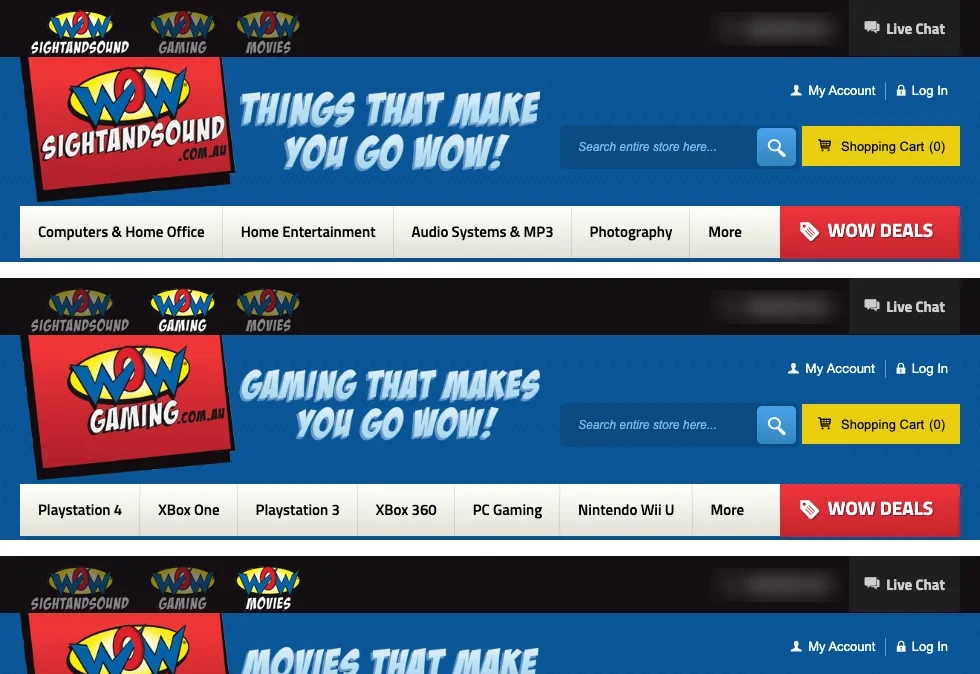
What multiple storefronts means
- Several shops a customer sees as separate, each with its own brand, line and catalogue.
- One platform underneath, so products, customers and orders sit in one place.
- A choice about the checkout. Some set-ups give every storefront its own cart; others let a buyer fill one cart from all of them.
- Check the platform’s actual boundaries. More than one storefront does not automatically mean a shared cart, account or checkout.
The example
In 2014 WOW Sight and Sound came back as an online retailer with three shops: Sight and Sound for electronics, Gaming for consoles and games, and Movies for films. We designed and built all three on one Magento installation.

Each shop had its own logo, its own line and its own departments. Underneath, they shared one cart and one checkout. A buyer could add a laptop in one shop, a game in the second and a film in the third, then pay once. The shop's own About page promised "a shared cart and one easy checkout".
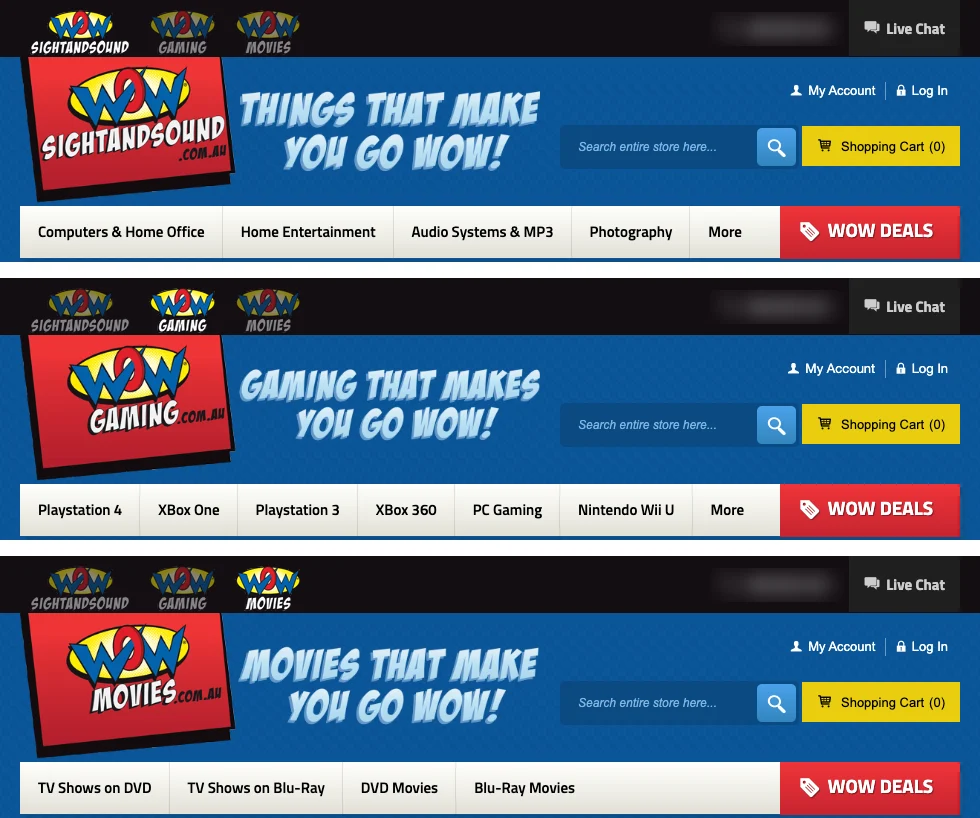
The build ran in every Web Archive capture from June 2014 to February 2017, 27 in all.
Why it works
Separate accounts and checkouts would have made a purchase across the three shops more involved. Shared records also reduced what the retailer would need to keep in step.
One platform moves the difference to the surface. The customer sees three shops. The business runs one.
When it does not fit
| Sharing may fit when | Separation may matter when |
|---|---|
| The shops sell to the same people | Each shop has its own customers |
| A buyer would pay once for things from more than one shop | Legal or payment requirements cannot share one checkout |
| The differences fit in a short list: logo, line, departments | Different owners want their own checkout |
| One team runs the catalogue | The shops should change on their own schedules |
A shared platform and a shared checkout answer different questions. The platform can serve the team running the shops; the checkout has to make sense to the customer buying from them.
Three questions before you decide
- Do the shops sell to the same people?
- Would a buyer want to pay once for things from more than one shop?
- Can the differences be named in a short list: logo, line, departments?
If all three answers are yes, assess a shared platform against the shops’ legal, payment and operating requirements. The WOW Sight and Sound case study shows the three shops, a category page and a product page from 2014, and our e-commerce page covers the rest of that work.
Multiple storefronts are a choice about what the customer sees. The platform underneath is a choice about what the business has to run, and the two do not have to match.