
What a VPAT tells you, and what to ask behind it
A VPAT is the form a supplier fills in to tell you how accessible its product is. The supplier writes it, about itself, and nobody checks it before it reaches you. That makes it a useful document and a weak proof.
Read each line as a claim. Then ask which test stands behind it.
What a VPAT is
- VPAT stands for Voluntary Product Accessibility Template. The Information Technology Industry Council (ITI) publishes it.
- Filled in, it becomes an Accessibility Conformance Report, or ACR. Procurement teams use both names for the same document.
- It comes in four editions. One each for the US government's Section 508 rules, the Web Content Accessibility Guidelines (WCAG) and the European standard EN 301 549, and an international edition that covers all three.
- It is self-reported. No agency approves it, and it is not a certificate. US federal agencies ask for one when they buy technology, and many enterprise procurement teams now ask too.
The four answers, and what each asks of you
Each row of a VPAT names one requirement and gives one of four answers.
| Answer | What the supplier is saying | What to ask |
|---|---|---|
| Supports | It meets the requirement, with no known defects. | Which test shows it, on how many pages, and when was it run? |
| Partially supports | Some parts do not meet it. | Which parts, and when will they be fixed? |
| Does not support | Most of it does not meet it. | Does it block a task your users must finish? |
| Not applicable | The requirement does not apply. | Why not? A site with video that says "not applicable" to captions needs a second look. |
The answer to watch is "Supports". It is the easiest to write, and the one a buyer is least likely to question.
One failure a test finds in a second
Discovery World Trekking is a trekking company whose website we look after. In September 2026 we started a design system for the live site and measured each part before changing it.
The Best Seller badge was white text on orange at 2.8 to 1. WCAG level AA asks for 4.5 to 1 for text of that size. Many visitors could not read it.
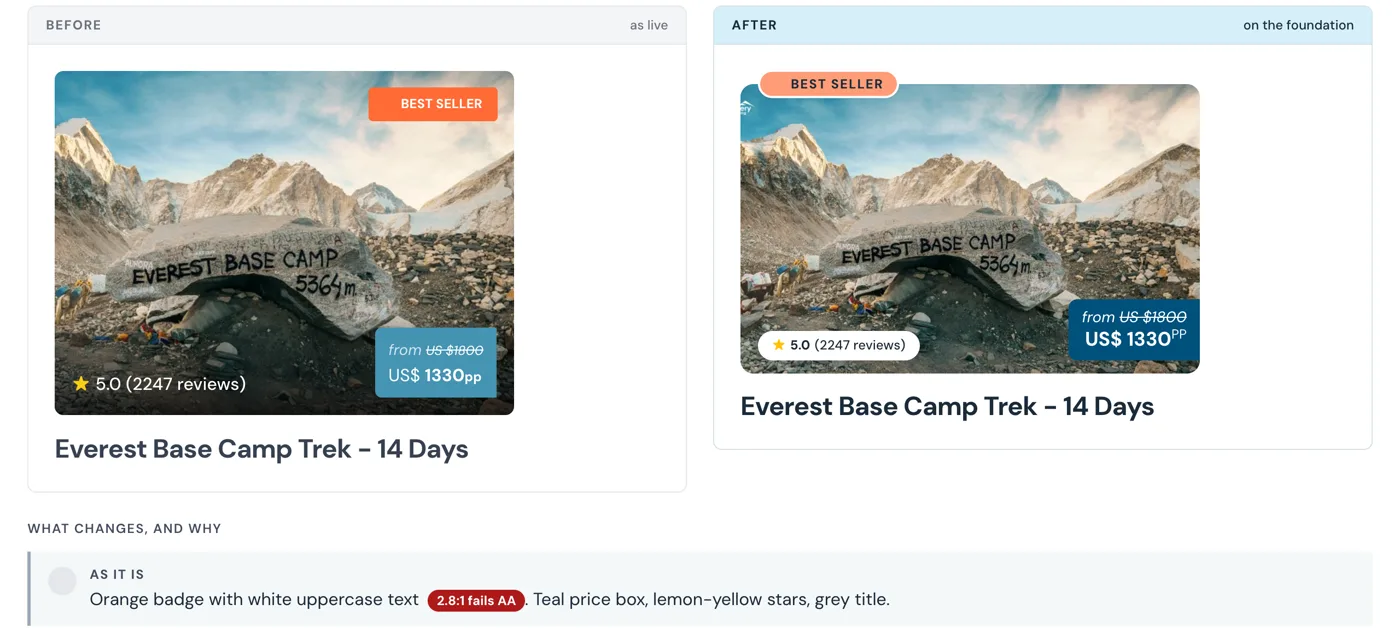
An automated contrast check finds this in a second. A VPAT would record it as one word against one requirement. The measured number is what tells you whether that word is true.
Five questions to ask behind any VPAT
- Which test stands behind each "Supports"? A named check that can run again, not a reviewer's impression.
- Does a failing test stop a release? If it only produces a report, the next release can undo the VPAT.
- How much was tested? Every page, or a sample?
- What was not tested? A screen reader used by hand, forms with errors, PDFs. An honest report names its gaps.
- Which version does it describe? A VPAT covers one release. A website that changes every week outgrows it quickly.
What we publish about our own site
Our accessibility statement holds this site to the same questions. Three automated checks run on every public page before any change goes live. One tests WCAG 2.1 AA and Section 508. One reads what a screen reader announces. One reads the page in the order it is spoken aloud. A change that fails any of them does not go live.
The statement also says what the checks do not cover. No independent body has audited the site. Nobody has yet tested it by hand with VoiceOver or NVDA, the screen readers on Apple devices and on Windows. Those are the two lines to look for in any supplier's report.
For clients, from 2017 to 2026, we built and looked after pharmaceutical, government and advocacy websites through a US agency, with accessibility checked as part of delivery. That case study is shared on request.
A VPAT with "Supports" on every line and no stated limit is not the strongest report. It is the one with the most left to check.
The work behind this post
Discovery World Trekking
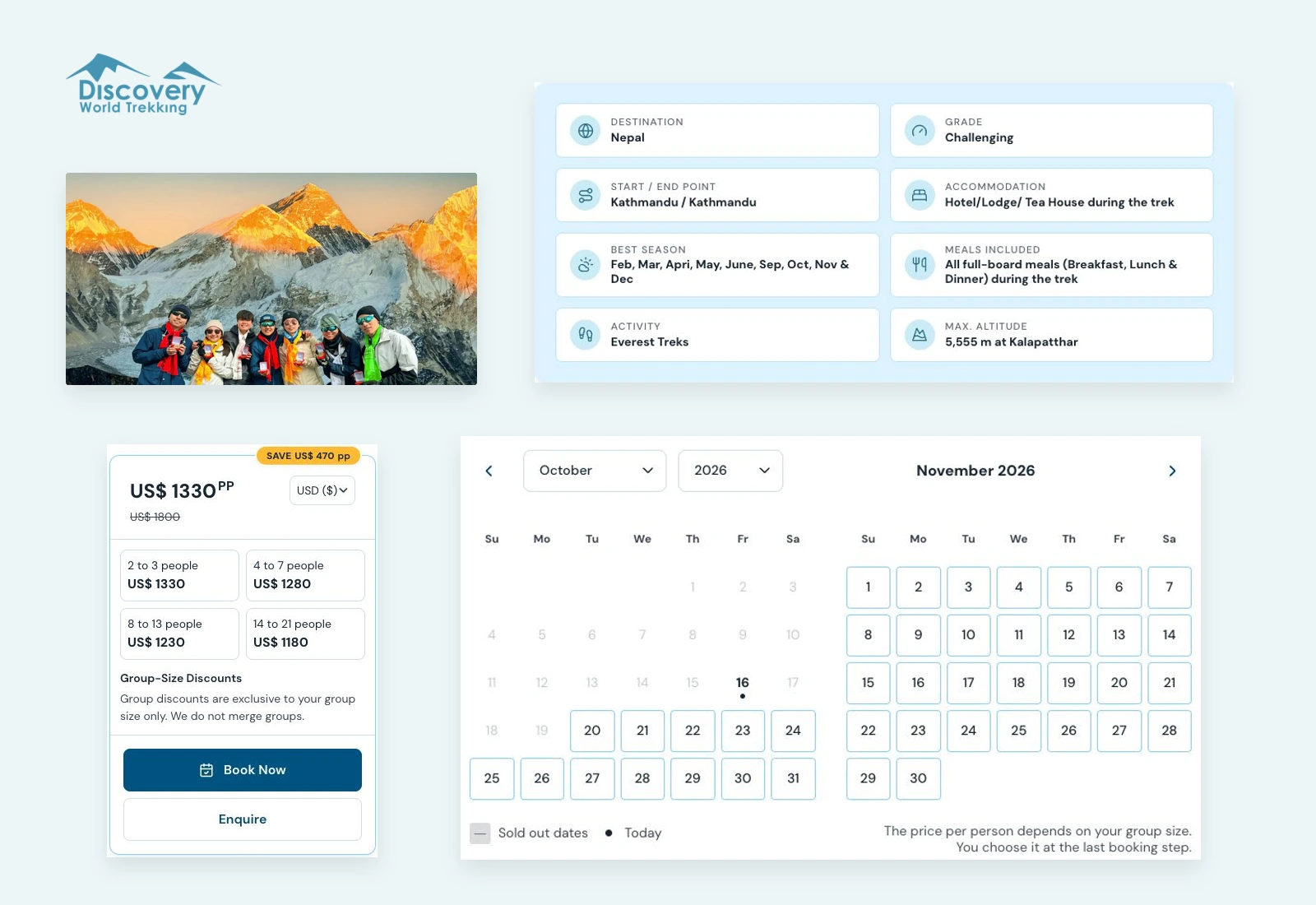
Design and engineering for Discovery World Trekking, connecting trip research with enquiries, bookings and advance payments.
White-label agency partner, US
Website engineering and maintenance alongside a US agency, with the agency holding its client relationships and review responsibilities.
Buying a website that has to pass an accessibility review?
Tell us which standard applies and who signs it off. We will say how we would test it, and what we would not claim.
Talk to us about your site