
A research consortium's website, redesigned in four months.
In 2014 we designed and built the website of EuroBATS, an EU-funded study of the biology of ageing led from King's College London, with five partners across Europe.
An EU study of ageing
EuroBATS, short for identifying Biomarkers of Ageing using whole Transcriptome Sequencing, was a research consortium funded by the EU's Seventh Framework Programme. The Department of Twin Research at King's College London led it, with the Wellcome Trust Sanger Institute, the University of Geneva, Spain's national cancer research centre CNIO and Life Length.
What the site needed
The consortium had eight pages of content, two published papers and a list of meetings. It needed a site that looked like serious research, explained the study's plan, and gave members a private area.
What we did
We designed the site and built it on a WordPress theme of our own. We redrew the study's plan in HTML and CSS, and set up the members area and the contact form. The work came to us through TwinsUK at King’s College London. The site went live in October 2014.
A small site, done properly
The dates come from the project's task lists; the pictures are from the Web Archive.
The brief
The consortium's site ran on a standard WordPress theme with a banner of plain type. The brief was short: a new look for eight pages of existing content, a search, and a private area where members could see the project's data. We designed the home page and the inner pages in June 2014.
The research, drawn
The study combined existing data from twins with new samples of skin, blood and fat. We redrew its plan as a strand of DNA leading to one analysis and five outputs, in HTML and CSS, so the team could edit it without a designer. The home page leads with the reason for the work: a population projection cited on the 2014 site. It projected a 70% rise in the EU’s population aged 65 and over by 2050.
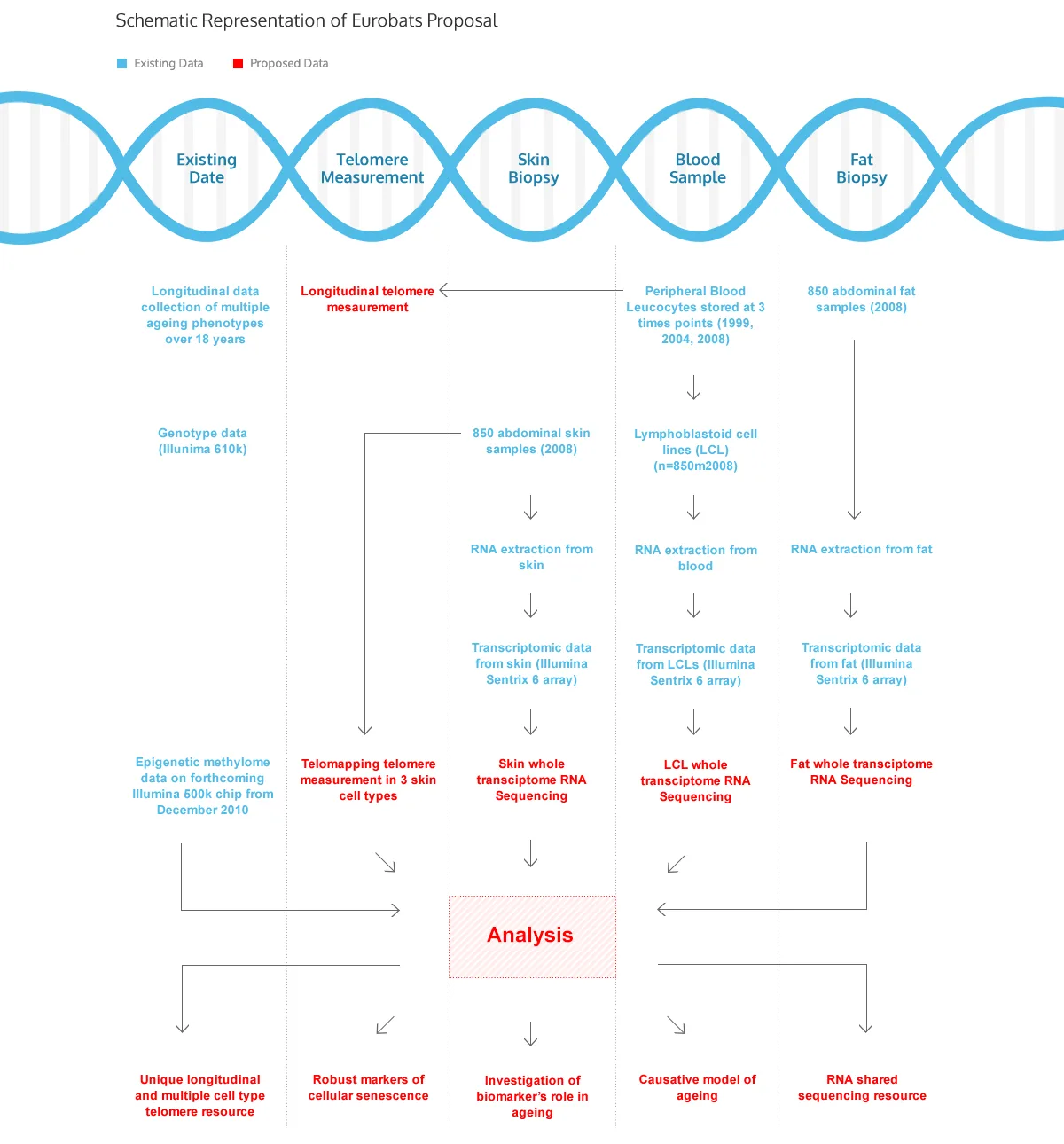
The study's plan, as the site drew it. View image full size Built, checked and live
We built the theme in August, then reviewed the code and tested it in the browsers of the day, back to Internet Explorer 8. The site went live on 6 October 2014 and ran unchanged for more than four years, with our credit in its footer.

Our credit in the footer, 2014. View image full size